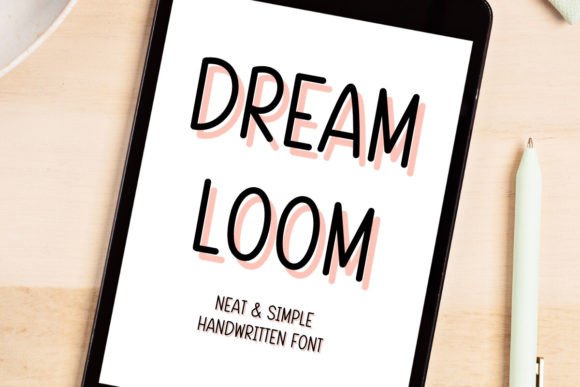
Dreamloom: A Handwritten Font That Sells Your Craft
As someone who prints candle labels at 2 a.m., cuts wedding tags on my Cricut before sunrise, and designs printable planners that actually get used—I need fonts that do more than look pretty. They need to work. Dreamloom isn’t just another script font. It’s the rare handwritten typeface that balances elegance with clarity, charm with commercial readiness—and it’s become my go-to for anything I sell in person, online, or as a digital download.
Dreamloom feels like ink drawn with care: smooth, consistent, and effortlessly graceful. It’s not overly flourished or hard to read at small sizes—no awkward loops that vanish when cut at ¼ inch, no thin strokes that break on kraft paper or vinyl. The letterforms are evenly spaced, the baseline is stable, and the lowercase ‘a’, ‘g’, and ‘y’ have just enough personality without sacrificing legibility. That’s why it reads beautifully on a 1.5-inch sticker for handmade soap, but also holds presence on a 24-inch farmhouse sign for a boutique coffee shop.
Where Dreamloom Fits Into Real Craft Projects
I’ve used Dreamloom across dozens of physical and digital products—and each time, it quietly lifts perceived value. Here’s how it lands in practice:
- Candle & product labels: Paired with a clean sans serif (like Montserrat or Poppins) for ingredients or scent names, Dreamloom handles the brand name or collection title with warmth and polish. Its even weight ensures crisp cutting on my Silhouette Cameo—even on textured label stock.
- Wedding stationery: From “Mr. & Mrs.” on foil-pressed invites to “Welcome” on acrylic welcome boards, Dreamloom adds sincerity without looking fussy. It’s readable at 10 pt for RSVP cards, and stunning at 72 pt for ceremony signage.
- Printable wall art & planner pages: Because Dreamloom includes standard ligatures and stylistic alternates (like a swashed capital ‘D’ or connected ‘th’), I can add subtle variation to digital downloads—without needing multiple fonts. Customers love that little extra detail in their Canva-editable files.
- SVG bundles & craft templates: As a Script Amp font, Dreamloom exports cleanly to SVG with minimal node clutter. No stray anchor points, no overlapping paths—just smooth curves that cut reliably on Cricut Design Space and Sure Cuts A Lot.
- Seasonal packaging: For holiday mugs, linen gift tags, or Easter egg labels, Dreamloom gives handmade goods that “designed-by-a-human” warmth—while still feeling cohesive across your shop’s branding.
Readability Matters—Especially When You’re Selling
Let’s be real: if your font doesn’t survive a 6-point print on a tea bag tag or a 3-inch vinyl decal on a ceramic mug, it’s not serving your business. Dreamloom shines here—not because it’s minimalist, but because it’s intentionally measured. The x-height is generous, counters are open, and stroke contrast is moderate (not ultra-thin to ultra-bold). That means:
- No lost letters when printed small on fabric or cut fine on adhesive vinyl.
- No confusion between ‘l’, ‘I’, and ‘1’—critical for product codes, dates, or personalization fields.
- Consistent spacing in mockups, so your Etsy previews look exactly like the final product.
I test every new font by printing a full alphabet at 8 pt on matte sticker paper and running it through my Cricut. Dreamloom passed on the first try—no double-cutting, no missing terminals, no kerning surprises.
Smart Pairings That Strengthen Your Brand
Dreamloom works best when paired intentionally—not just “script + sans” as default, but with purpose. I keep two pairings in rotation:
- Elegant contrast: Dreamloom + a warm, low-contrast serif (think Playfair Display or Cormorant Garamond). Use Dreamloom for headlines and names; the serif for body text on invitations or product descriptions. This combo signals craftsmanship and attention to detail—ideal for luxury candles, apothecary goods, or bridal shops.
- Modern clarity: Dreamloom + a friendly geometric sans (like Nunito or Quicksand). Perfect for digital printables, social media graphics, or kids’ birthday kits. The script adds playfulness; the sans grounds it in usability.
What I avoid? Pairing Dreamloom with another script—or stacking it with fonts that compete for attention. Its strength is quiet confidence, not chaos.
Licensing, Formats, and What You Actually Get
Dreamloom comes in OTF and TTF formats—both fully compatible with Cricut Design Space, Silhouette Studio, Adobe Creative Cloud, and Canva. It supports multilingual Latin-based languages (including accented characters for French, Spanish, and German), which matters if you sell internationally or design bilingual baby announcements.
Importantly, Dreamloom is licensed for commercial use—meaning you can use it to create and sell physical products (stickers, mugs, apparel), digital downloads (planner pages, SVG files, Canva templates), client work, and even merchandise with your own logo. Just check the license terms for limits on total sales volume or redistribution rights—most Script Amp fonts allow unlimited physical sales and up to 5,000 digital units per license, which covers most small shops comfortably.
One practical note: always embed Dreamloom in PDFs for print-ready files, and convert to outlines before sending SVGs to production. That preserves your intended spacing and prevents font substitution on buyers’ machines.
Dreamloom doesn’t shout. It invites. It reassures. And in a crowded marketplace where handmade goods compete on feeling as much as function, that quiet confidence makes all the difference—on a shelf, in a cart, or framed on someone’s wall.